
Chlamydomonas is organism of a genus of single-celled, freshwater green algae found in ponds and other still water bodies. The organism is microscopic and has a cup-shaped chloroplast, two flagella used for movement, and an eyespot that detects light. It swims toward light to carry out photosynthesis, a behaviour known as phototaxis.[1] 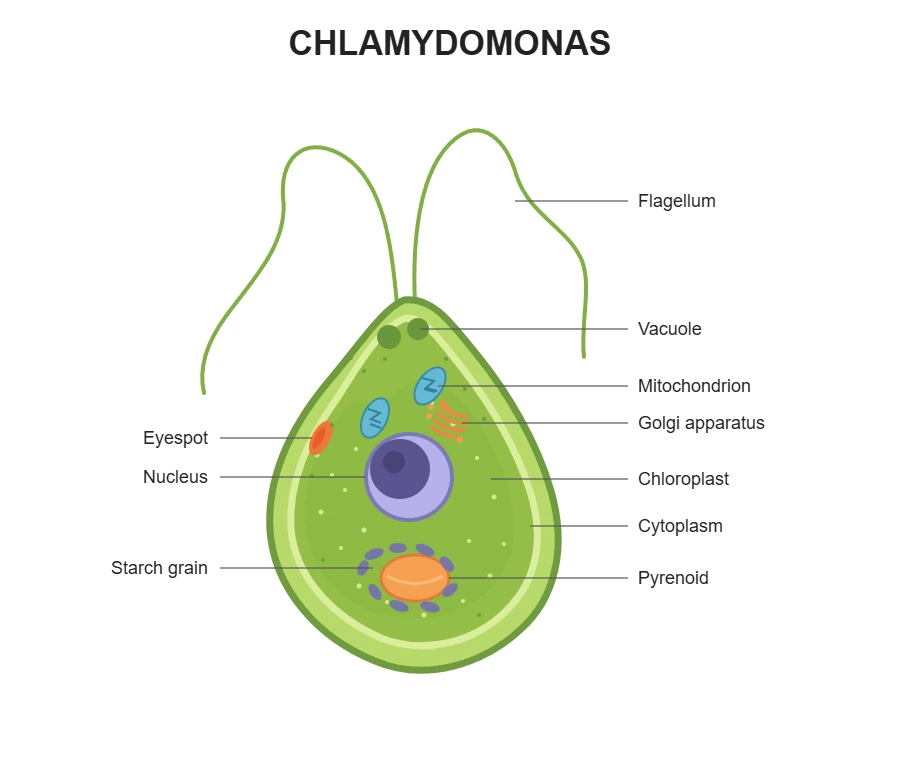
Discovery of channelrhodopsin
In the early 2000s, Peter Hegemann and Georg Nagel investigated how Chlamydomonas senses light. They identified channelrhodopsin, a light-sensitive protein on the cell surface. When exposed to blue light, the protein opens to form a channel and allows ions to pass through the cell membrane, producing an electrical signal.[2]
Optogenetics
Karl Deisseroth later introduced the gene for channelrhodopsin into nerve cells, enabling researchers to control neurons using light. This technique became known as optogenetics.
2026 Nobel Prize
The 2026 Nobel Prize in Physiology or Medicine was awarded jointly to Karl Deisseroth, Peter Hegemann and Georg Nagel "for their discoveries concerning light-gated ion channels and optogenetics."[3]
Significance
Optogenetics is used to study how the brain governs memory, emotion and behaviour, and may contribute to treatments for neurological disorders. The work illustrates how research on simple organisms can lead to major advances in human medicine.
Chlamydomonas species
- Chlamydomonas acidophila
- Chlamydomonas nivalis
- Chlamydomonas ovoidae
- Chlamydomonas reinhardtii
- Chlamydomonas caudata Wille
- Chlamydomonas moewusii[4]
Select a year and month above to explore cold archived discussions.
Please select an archived topic above to view the discussion logs.